



Kathmandu's UNESCO World Heritage Sites: A Complete 4-Day Guide
Kathmandu's UNESCO World Heritage Sites: A Complete 4-Day Guide
Kathmandu Valley is home to seven UNESCO-listed monument zones: the Durbar Squares of Kathmandu, Patan, and Bhaktapur, the stupas of Swayambhunath and Boudhanath, Pashupatinath Temple, and Changu Narayan Temple. All seven sit within about 15 kilometers of each other, so a focused traveler can see every one of them in four days and still have time for the valley's gardens, markets, and viewpoints.
This guide walks through what each site is, what it costs to get in, and how to sequence a 4-day visit. If you'd rather have someone else handle the logistics, our Kathmandu World Heritage Sites tour (3 nights, 4 days) covers the same ground with a guide and private transport included.
Why is Kathmandu Valley a UNESCO World Heritage Site?
UNESCO added Kathmandu Valley to its World Heritage List in 1979 for the Newar architecture built under the Malla kings between the 12th and 18th centuries, and for the fact that the valley's temples and stupas are still active places of worship rather than museum pieces. Pashupatinath still hosts cremations on the Bagmati River every day. Boudhanath's prayer wheels are still spun by Tibetan Buddhist pilgrims. The Durbar Squares were royal palaces first and tourist sites second.
How many UNESCO sites are actually in Kathmandu?
This trips up a lot of travelers, and a lot of blogs get it wrong. Officially, Nepal has four UNESCO World Heritage Sites: Kathmandu Valley and Lumbini (cultural), and Chitwan and Sagarmatha National Parks (natural). Kathmandu Valley counts as a single listing, but it's made up of seven separate monument zones, which is where the "seven UNESCO sites in Kathmandu" figure comes from. Add the other three national listings and some sources count "ten" heritage sites in Nepal, treating each Kathmandu monument zone as its own entry. Either way, for a visitor planning a trip, the number that matters is seven: that's how many individual sites you can actually walk into around Kathmandu.
Kathmandu's 7 UNESCO sites at a glance
| Site | Known for | Nepali citizens | SAARC nationals | Other foreign nationals |
|---|---|---|---|---|
| Pashupatinath Temple | Nepal's holiest Shiva temple, on the Bagmati River | Free (only Hindus may enter the main temple) | NPR 1,000 | NPR 1,000 |
| Boudhanath Stupa | One of the largest Buddhist stupas in the world | Free | NPR 100 | NPR 400 |
| Swayambhunath Stupa | Hilltop stupa known as the Monkey Temple | Free | NPR 50 | NPR 200 |
| Kathmandu Durbar Square | Former royal palace complex, old city center | Free | NPR 500 | NPR 1,000 |
| Patan Durbar Square & Museum | Newar craftsmanship and the Krishna Mandir | NPR 30 | NPR 250 | NPR 1,000 |
| Bhaktapur Durbar Square | Best-preserved medieval city in the valley | Free | NPR 500 | NPR 1,800 |
| Changu Narayan Temple | Nepal's oldest Hindu temple, 6 km from Bhaktapur | Free | NPR 100 to 250 | NPR 300 to 400 |
Entry fees at government-run sites change from time to time, so treat these as a planning estimate and confirm at the ticket counter. If you're staying more than a few days, ask at the tourism office next to Kumari Ghar in Kathmandu Durbar Square about a long-stay ticket. It costs the same as a single day pass but works for your whole visa period.
A 4-day itinerary for Kathmandu's UNESCO sites
Day 1: Pashupatinath Temple and Boudhanath Stupa
Start at Pashupatinath early, before the tour buses arrive. Non-Hindus can't enter the inner sanctum, but the surrounding complex along the Bagmati River is open, and it's where you'll see the cremation ghats, resident sadhus, and the temple's pagoda-style architecture up close. Give it 90 minutes to two hours.
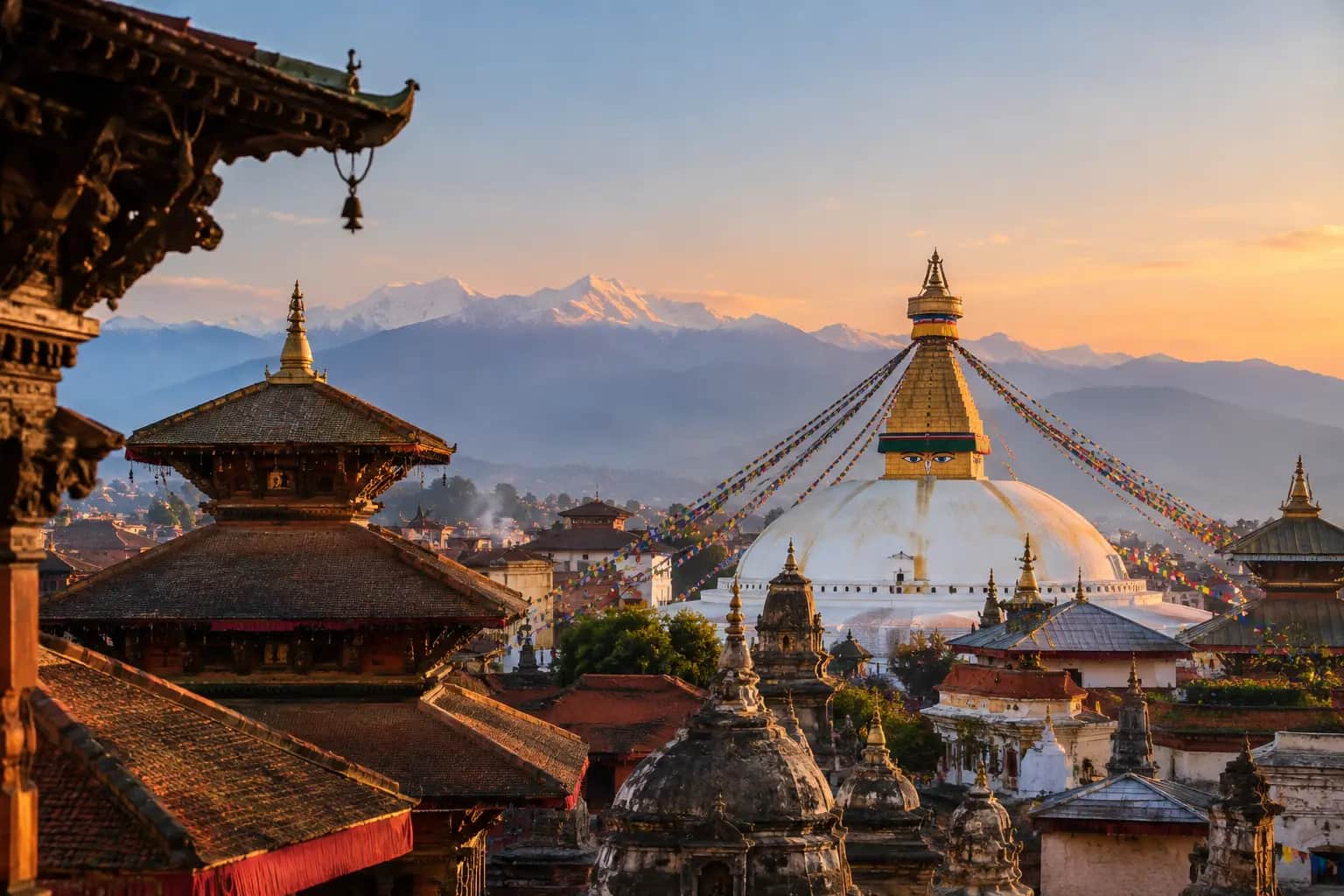
In the afternoon, head to Boudhanath. The stupa is one of the largest in the world and the center of Tibetan Buddhist life in Kathmandu. Walk clockwise around it, as is customary, and stop at one of the rooftop cafés ringing the plaza for a view over the whole site as the evening butter lamps get lit.
Day 2: Swayambhunath Stupa and Kathmandu Durbar Square
Swayambhunath, the Monkey Temple, sits on a hilltop with panoramic views of the valley. You can climb the 365 stone steps on the eastern side or take the longer, gentler road route if stairs aren't your thing. Either way, go in the morning when the light and the crowds are both easier to deal with.
From there, move to Kathmandu Durbar Square. This was the seat of the Malla and later Shah kings, and the ticket includes the Hanuman Dhoka Palace complex and the Kumari Ghar, home to Kathmandu's living goddess. Budget at least two hours; there's a lot packed into a small footprint.
Day 3: Patan Durbar Square and Patan Museum
Patan, across the Bagmati River in Lalitpur, has the most refined stonework and metalwork of the three Durbar Squares. The Krishna Mandir, built entirely from stone rather than the brick and wood used elsewhere in the valley, is the standout. It follows the Shikhara style found across Indian temple architecture rather than the pagoda style used everywhere else in Patan, and legend has it King Siddhi Narsingh Malla built it after dreaming that Krishna and Radha appeared before his palace. The Patan Museum, housed in a former royal residence inside the square, is widely considered the best-curated museum in Nepal and worth the extra hour if you're at all interested in bronze casting or Newar religious art.
Day 4: Bhaktapur Durbar Square, with Changu Narayan as a half-day add-on
Bhaktapur is the most intact of the three medieval cities, largely because it's set apart from Kathmandu's urban sprawl. Plan for a full morning around the 55-Window Palace, the Nyatapola Temple, and Pottery Square, where you can watch potters working at the wheel the way their families have for generations.
Changu Narayan, Nepal's oldest Hindu temple, is about 6 kilometers northeast of Bhaktapur. The road winds through hills, so budget 20 to 45 minutes by taxi depending on traffic. If you have the energy, it's a natural add-on to close out your fourth day and complete all seven sites. The temple holds an inscription from 464 CE, among the oldest in the valley, though the structure itself has been rebuilt more than once after a fire in 1702 and earthquake damage in 2015.
Beyond the UNESCO list: more of Kathmandu worth your time
Narayanhiti Palace Museum
The former residence of Nepal's royal family, converted into a public museum after Nepal became a republic in 2008. You can walk through the state rooms and private quarters much as they were left, which makes it one of the more direct windows into the country's recent political history. It's a short walk from Thamel.
Garden of Dreams
A walled neo-classical garden built in the 1920s, with pavilions, fountains, and a small café. It's one of the few genuinely quiet spots in central Kathmandu, which is exactly why people use it to decompress between temple visits. Entry runs NPR 400 for foreign visitors and NPR 150 for Nepali citizens.
Botanical Garden Godawari
Located at the foot of the Phulchowki hills in the southern part of the valley, this is a working botanical garden rather than a manicured park, with walking trails and a wide range of native and introduced plant species. Spring is the best season, when the flowering trees are in bloom. It pairs well with our Nepal Family Tour if you're traveling with kids and want a break from temple-hopping.
Thamel
Kathmandu's tourist district, packed with guesthouses, trekking gear shops, restaurants, and bars. It's the obvious base for exploring the valley and a reasonable place to end most evenings.
Shivapuri National Park
A forested park on the valley's northern rim, known for hiking trails, birdwatching, and a couple of waterfalls. On a clear day the ridge trails give you a distant look at the Himalayas.
Kathmandu Central Zoo
Nepal's only zoo, in Jawalakhel, Lalitpur. It's a straightforward family outing with a fair range of native and exotic species, plus a small lake for paddle boating.
Kathmandu Fun Park
An amusement park in Bhrikutimandap with rides aimed at kids and families. Good for an afternoon if you're traveling with young children who've had enough of temples for one day.
Taragaon Museum
A private museum near Boudhanath, built on the site of a 1970s artists' hostel designed by the Austrian architect Carl Pruscha. It documents how Kathmandu's architecture and cityscape changed after the country opened to foreign visitors in the 1950s, through photographs, sketches, and maps dating back to the 19th century. Entry is inexpensive and it rarely gets crowded.
Nepal Art Council
A nonprofit gallery in Babar Mahal that's been running since 1962, with rotating exhibitions of Nepali and international contemporary art. Worth checking if something is on during your visit, since the schedule changes throughout the year.
ISKCON Nepal (Sri Radha Govinda Temple)
A Hare Krishna temple in Budhanilkantha, on the edge of the Shivapuri Conservation Area, about ten minutes' walk from the older Budhanilkantha Temple. It's a quieter, more contemplative stop than the valley's main pilgrimage sites, with a well-kept garden.
Shree Pancha Mahalaxmi Temple, Sankhu
A Hindu temple dedicated to five forms of the goddess Laxmi, located near Sankhu on the valley's eastern edge, close to Changu Narayan. It's become popular on social media in the past couple of years for its distinctive South Indian-style architecture, which stands out against the valley's usual pagoda style.
Best time to visit Kathmandu's heritage sites
October and November is peak season. Skies are clear after the monsoon, temperatures are comfortable, and Dashain and Tihar, Nepal's two biggest festivals, both fall in this window. Book accommodation ahead if you're traveling then.
March and April brings warmer weather and blooming rhododendrons in the surrounding hills, plus Holi in March if you want to be in the thick of it.
December to February is cold but manageable; Kathmandu itself rarely drops below freezing. Fewer tourists mean shorter lines at the ticket booths and lower hotel rates.
June to August, the monsoon, is the one stretch worth avoiding for heritage sightseeing. Heavy rain, landslide risk on mountain roads, and overcast skies make it a poor match for a walking-heavy itinerary. The exception is Gunla, the Buddhist month that usually falls in August, which is one of the more spiritually significant times of year in Newar Buddhism if that's specifically what you're after.
Practical tips for visiting
- Wear shoes you can walk and climb stairs in. Every site involves both.
- Take your shoes off before entering temple interiors, and walk clockwise around stupas, following the direction locals use.
- Visit early morning when you can. Pashupatinath and Boudhanath in particular are calmer before mid-morning.
- Carry cash. Most ticket counters don't take cards, and you'll want small notes for entry fees and local transport.
- A local guide adds a lot at Kathmandu, Patan, and Bhaktapur Durbar Squares specifically, since so much of what's interesting there is in the details of individual carvings and courtyards that are easy to walk past.
- A private car or driver for the day is worth it if you're covering Patan and Bhaktapur on the same trip; public transport between them eats into your sightseeing time.
Plan your Kathmandu heritage trip with Himalaya Vibes Holidays
We handle the guided tours, private transport, and scheduling so you can spend your time actually looking at the sites instead of figuring out logistics. Our Kathmandu World Heritage Sites tour (3 nights, 4 days) covers all seven sites in this guide. If you want to extend the trip, our 3-day Nepal cultural tour with Nagarkot and Chitwan National Park safari both pair naturally with a Kathmandu heritage circuit.
Commonly Asked Questions