



Best Time to Visit Bhutan: Month-by-Month Guide
The best time to visit Bhutan depends on what you want from the trip.
Spring brings blooming rhododendrons, pleasant temperatures and major festivals. Autumn is known for clear skies, comfortable conditions and some of Bhutan's most popular cultural events. Summer brings monsoon rain, but also exceptionally green valleys, waterfalls and fewer visitors. Winter is colder, especially at higher elevations, but brings crisp skies, quieter trails and good conditions for mountain views in many areas.
Bhutan is a year-round destination, but the experience changes considerably from season to season because of the country's wide range of elevations and climates.
If you are deciding when to travel, the most useful question is not simply "What is the best month to visit Bhutan?" It is what do you want to see and do while you are there?
When Is the Best Time to Visit Bhutan?
For many first-time visitors, spring and autumn are the easiest seasons for combining comfortable sightseeing conditions, cultural experiences and mountain scenery.
If you are still deciding what type of Bhutan trip you want, start with our Bhutan Tour Packages, which covers the main itineraries and travel styles available.
Visit Bhutan in spring if you want:
- Rhododendron and other spring blooms
- Pleasant temperatures
- Major festivals such as Paro Tshechu
- Good conditions for hiking and outdoor activities
- Strong birdwatching opportunities
Visit Bhutan in autumn if you want:
- Clearer mountain views
- Comfortable temperatures for sightseeing
- Major festivals such as Thimphu Tshechu
- Hiking and trekking
- Harvest-season landscapes and cultural experiences
Visit Bhutan in summer if you want:
- Lush green valleys
- Waterfalls and monsoon landscapes
- Fewer visitors
- A quieter travel experience
- Flexible sightseeing around periods of rain
Visit Bhutan in winter if you want:
- Crisp, clear days
- Fewer tourists
- Mountain views
- Winter festivals
- Black-necked cranes in Phobjikha Valley
Bhutan's Department of Tourism describes all four seasons as offering different reasons to visit, rather than identifying one universally correct travel period.
Bhutan Weather by Season
Bhutan has four main seasons: spring from March to May, summer from June to August, autumn from September to November and winter from December to February.
However, these dates are only a broad guide. Bhutan's climate changes significantly with elevation and location. Southern Bhutan is warmer and more humid, central areas have a temperate climate, while northern and high-altitude regions are much colder.
Spring in Bhutan: March to May
Spring is one of the most popular periods for visiting Bhutan.
The season begins with generally dry, pleasant conditions, while flowers and vegetation become increasingly prominent as spring progresses. The official tourism authority describes early spring as generally dry and highlights the country's flowering landscapes during this period.
March
March marks the beginning of spring.
Paro, Thimphu and Punakha can be good bases for cultural sightseeing, while higher elevations remain cold. The landscape begins changing as spring arrives, and the month can be particularly interesting for travelers combining cultural visits with outdoor activities.
In the official 2026 festival calendar, Punakha Tshechu runs from February 27 to March 1, followed later in the month by Paro Tshechu from March 29 to April 2.
April
April is one of the strongest months for combining cultural sightseeing and spring scenery.
The hillsides begin to show more color, temperatures become more comfortable and outdoor activities become increasingly attractive.
Paro Tshechu takes place from March 29 to April 2 in 2026, with the Thongdrol scheduled for the final day according to Bhutan's official festival calendar.
April is also within the recommended season for several Bhutan trekking routes. The official tourism portal lists the Dagala Thousand Lakes Trek among routes suitable for April, May, June, September and October.
May
May is warmer and greener, with increasing humidity as the summer weather approaches.
It can be a useful month for travelers who want spring landscapes without concentrating their trip around the major March and April festivals.
May is also one of the stronger months for birdwatching. Bhutan's tourism authority identifies March through May as the peak season for birdwatching.
Summer in Bhutan: June to August
Summer coincides with the southwest monsoon influence, particularly from late June or July through late September. Rainfall patterns vary considerably across Bhutan, however, and the country's high elevations and geography mean that conditions are not identical everywhere.
The trade-off is straightforward: rain can make travel less predictable, but the landscape becomes exceptionally green.
June
June is a transition month.
Early June can still offer useful conditions for sightseeing and trekking, while rainfall generally becomes more influential as the month progresses.
The official Bhutan tourism calendar also includes summer cultural events such as Nimalung Tshechu from June 22 to 24, 2026, followed by Kurjey Tshechu on June 24.
July
July falls within Bhutan's wetter summer period.
Mountain views can be less predictable, and rain can affect roads and outdoor activities. The official tourism authority notes that monsoon conditions can affect transportation and services from June through September.
At the same time, summer produces some of Bhutan's richest green landscapes, with thriving vegetation, flowing waterfalls and agricultural fields.
For travelers who prioritize scenery and cultural experiences over guaranteed mountain visibility, July can still be worthwhile.
August
August remains part of the summer monsoon period.
Rain is a consideration when planning road travel and outdoor activities, but the countryside is at its greenest. Bhutan's tourism authority also highlights summer festivals and cultural events during this period.
If you travel in August, allow some flexibility in your itinerary rather than planning every outdoor activity around a fixed weather window.
Autumn in Bhutan: September to November
Autumn is one of Bhutan's most popular travel seasons.
The monsoon influence gradually decreases, and the official tourism authority describes autumn as a period of bright, sunny days, harvest activity and festivals.
September
September is a transition from summer into autumn.
Rain can still occur, particularly early in the month, but conditions generally become more favorable as the season progresses.
The 2026 festival calendar lists Thimphu Tshechu from September 21 to 23, while Gangtey Tshechu follows from September 24 to 26.
September is also one of the recommended months for the Dagala Thousand Lakes Trek.
October
October is one of the most attractive months for travelers who want a combination of comfortable weather, mountain scenery and outdoor activities.
The monsoon has generally receded, and the official tourism material describes autumn as a period of pleasant weather and clearer skies.
October is also a particularly active month for Bhutanese festivals. The 2026 calendar includes the Jhomolhari Mountain Festival on October 14 and 15, as well as several tshechus later in the month.
For trekking, October is listed as a suitable month for the Dagala Thousand Lakes Trek, as well as several other routes.
November
November is cooler, but often provides crisp conditions and good visibility.
It is also an important month for wildlife experiences. The Black-Necked Crane Festival is scheduled for November 11, 2026, at Gangtey Gonpa in Phobjikha Valley.
The black-necked cranes normally arrive in Bhutan during autumn and spend the winter months in areas including Phobjikha Valley. Bhutan's tourism authority identifies their wintering period as an important seasonal wildlife experience.
Winter in Bhutan: December to February
Winter is Bhutan's coldest season, particularly at higher elevations.
The official tourism authority describes winter as crisp, clear and sunny, with frost common across much of the country and snowfall more likely above 3,000 metres.
Paro and Thimphu can be cold, but lower valleys such as Punakha generally remain more comfortable.
December
December can be a good choice for travelers who prefer quiet sightseeing and crisp winter conditions.
Higher mountain passes can be very cold, but the clear winter atmosphere can provide excellent mountain views.
The 2026 festival calendar includes Druk Wangyel Tshechu at Dochula on December 13 and Trongsa Tshechu from December 17 to 21.
January
January is cold, particularly in Paro, Thimphu and at higher elevations.
It is not the obvious choice for travelers focused on warm-weather hiking, but it can work well for cultural sightseeing, photography and travelers who prefer quieter destinations.
The official tourism authority notes that winter skies can be extremely clear, making the season particularly appealing for Himalayan views and photography.
February
February remains cold at higher elevations, while lower valleys such as Punakha can be relatively mild.
February is also an important festival month. In 2026, Punakha Dromchoe is scheduled for February 24 to 26, followed by Punakha Tshechu from February 27 to March 1.
The winter season also provides an opportunity to see black-necked cranes in Phobjikha Valley before they return north later in the season.
Bhutan Month-by-Month Travel Guide
| Month | Weather and Conditions | What to Experience |
|---|---|---|
| January | Cold, generally crisp and clear | Quiet sightseeing, winter landscapes, mountain views |
| February | Cold, with milder conditions in lower valleys | Punakha festivals, winter landscapes, black-necked cranes |
| March | Spring begins, conditions become milder | Spring landscapes, festivals, hiking |
| April | Mild and increasingly green | Paro Tshechu, spring flowers, hiking and trekking |
| May | Warmer, greener and increasingly humid | Rhododendrons, birdwatching, outdoor activities |
| June | Transition toward summer rainfall | Green landscapes, selected trekking routes, cultural festivals |
| July | Wet and humid in many areas | Lush valleys, waterfalls, quieter travel |
| August | Monsoon influence continues | Green landscapes, cultural experiences, fewer visitors |
| September | Rain gradually decreases | Thimphu Tshechu, trekking, improving mountain visibility |
| October | Generally pleasant and clearer | Mountain views, trekking, festivals |
| November | Cool, crisp and increasingly dry | Black-necked cranes, mountain views, cultural experiences |
| December | Cold and generally clear | Winter festivals, quiet sightseeing, photography |
Bhutan's climate varies by elevation and region, so this table should be treated as a planning guide rather than a guarantee of daily conditions.
When Is the Best Time to Trek in Bhutan?
The best trekking season depends on the route and elevation.
For theDagala Thousand Lakes Trek, Bhutan's official tourism portal lists April, May, June, September and October as suitable months.
Other routes have different recommended seasons. The official portal lists the Druk Path Trek from March through June and September through November, while the Jomolhari Trek is listed for September through November.
This is why it is better to choose your trekking route before deciding which month to visit.
For travelers interested specifically in Dagala, see our Dagala Thousand Lakes Trek itinerary for the route, duration and altitude details.
When Is the Best Time to Visit Bhutan for Festivals?
Bhutan has festivals throughout the year, so festival travel is not limited to spring and autumn.
Some of the most useful festival periods for travelers include:
Paro Tshechu
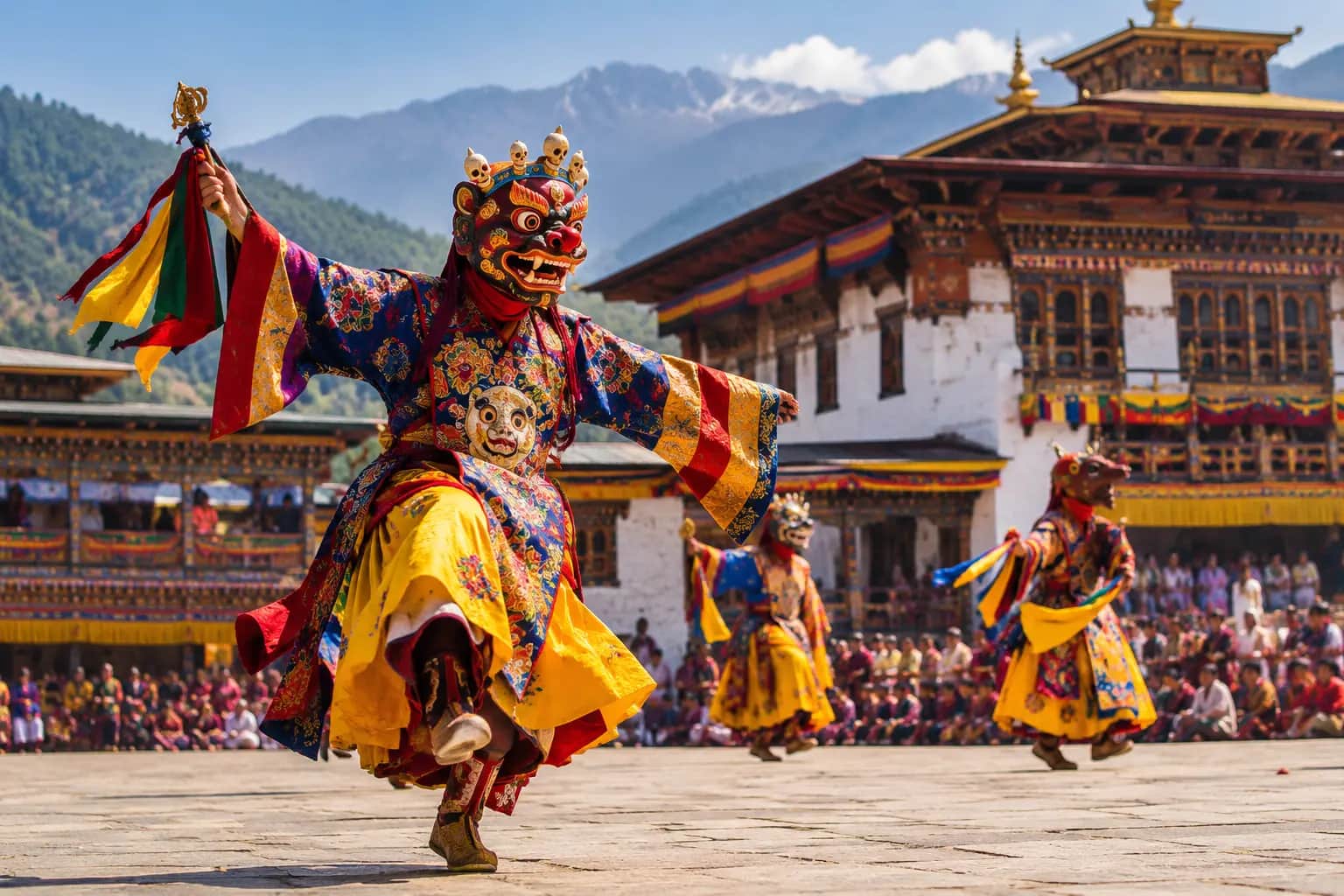
One of Bhutan's best-known festivals, Paro Tshechu is held at Rinpung Dzong.
In 2026, it is scheduled for March 29 to April 2, with the Thongdrol on the final day.
Thimphu Tshechu
Thimphu Tshechu takes place in the capital and is one of the major events on Bhutan's annual festival calendar.
The 2026 dates are September 21 to 23.
Punakha Tshechu
Punakha's festival is particularly useful to consider if your itinerary already includes Punakha.
In 2026, Punakha Tshechu is scheduled for February 27 to March 1, immediately following Punakha Dromchoe.
Black-Necked Crane Festival
The Black-Necked Crane Festival takes place at Gangtey Gonpa in Phobjikha Valley.
The 2026 festival is scheduled for November 11. The cranes themselves are seasonal visitors to Bhutan and can be seen in Phobjikha during the winter period.
If festivals are the main reason for your trip, check the official Bhutan festival calendar before booking because dates can change.
For a broader look at the cultural events worth planning around, see our Bhutan Festivals Guide once the guide is published.
When Is the Best Time to Visit Bhutan for Mountain Views?
For travelers whose priority is Himalayan scenery, autumn and winter are generally strong choices because Bhutan's official tourism information highlights clearer skies during these periods.
October and November can offer a useful balance between comfortable daytime conditions and mountain visibility.
Winter can provide exceptionally crisp skies, although temperatures drop substantially at higher elevations.
Summer is less predictable for long-distance mountain views because of monsoon conditions.
When Is the Best Time to Visit Bhutan for Fewer Tourists?
If avoiding busy travel periods is your priority, consider the shoulder and winter months rather than planning around the major spring and autumn festivals.
Summer can also be quieter because of the monsoon season, although travelers need to accept greater weather uncertainty and possible disruption to road travel. Bhutan's Department of Tourism specifically notes that monsoon conditions can affect transportation and services from June to September.
Winter is another option for travelers who do not mind colder temperatures.
Which Bhutan Tour Is Best for Each Season?
The right itinerary depends on both the season and what you want to do.
Spring: Cultural Tours and Trekking
Spring works well for travelers who want cultural sightseeing combined with flowers, pleasant conditions and outdoor activities.
The Golden Triangle Bhutan Tour andMajestic Bhutan both include Paro, Thimphu and Punakha, making them suitable options for travelers who want a western Bhutan cultural circuit.
Spring is also a useful period for trekking routes such as Dagala Thousand Lakes, depending on the specific dates and trail conditions.
Summer: Flexible Cultural Travel
Summer is better suited to travelers who are comfortable with rain and want greener landscapes and fewer visitors.
A flexible cultural itinerary can work well because sightseeing can be adjusted around weather conditions.
Autumn: Cultural Tours and Trekking
Autumn is particularly useful for travelers who want to combine cultural sightseeing, festivals, mountain scenery and trekking.
TheGolden Triangle Bhutan Tour, 6 Days adds Punakha and Dochula Pass to a Paro and Thimphu itinerary, while theMajestic Bhutan, 7 Days gives travelers more time across the same western Bhutan circuit.
Dagala Thousand Lakes is also listed by Bhutan's tourism portal as a suitable trek for September and October.
Winter: Cultural and Wildlife Experiences
Winter can be a good fit for travelers who prefer quieter sightseeing, clear winter skies and seasonal wildlife.
Punakha is particularly attractive during the colder months because its lower elevation gives it a milder climate than many higher parts of Bhutan.
What Is the Best Month to Visit Bhutan?
There is no single answer that works for every traveler.
October is a strong choice if your priority is a combination of clearer weather, mountain views, cultural sightseeing and outdoor activities.
April is particularly attractive for spring scenery and the Paro festival period.
November works well for travelers interested in clear conditions and black-necked cranes.
February and March are worth considering if Punakha's winter festivals are a priority.
July and August make more sense for travelers who value lush landscapes and quieter travel and do not mind rain.
The most important thing is to choose your activities first and your travel month second.
Plan Your Bhutan Trip Around the Season
Once you know when you want to visit, the next step is choosing an itinerary that fits the season.
For an overview of routes and travel styles, start with our Bhutan Tour Packages guide.
If you are looking for a six-day cultural journey through Paro, Thimphu and Punakha, explore the Golden Triangle Bhutan Tour.
For a seven-day version with more time for sightseeing, see Majestic Bhutan.
For a dedicated mountain experience, explore the Dagala Thousand Lakes Trek, which is listed by Bhutan's tourism authority as a seasonal trek suitable for April, May, June, September and October.
If you are planning around visa requirements and the Sustainable Development Fee, read our Bhutan Visa & SDF Guide before booking.
For a clearer picture of what your trip may cost, see our Bhutan Tour Cost Guide.
Start Planning Your Bhutan Journey
Bhutan does not have one perfect travel season. Spring, summer, autumn and winter each offer a different combination of weather, landscapes, festivals and activities.
Choose the season around what you want to experience, then choose the itinerary that fits.
Explore our Bhutan Tour Packages for cultural journeys through Paro, Thimphu and Punakha, or choose the Dagala Thousand Lakes Trek if trekking is the main focus of your trip.
For visa and Sustainable Development Fee information, read our Bhutan Visa & SDF Guide. For a clearer picture of what your trip may cost, see our Bhutan Tour Cost Guide.
Last reviewed: September 2026
Festival dates and weather conditions can change. The 2026 festival dates above are based on Bhutan's published 2026 tentative festival calendar and should be reconfirmed before booking.
Commonly Asked Questions